Infant Visual Development
Babies explore their world through their senses- especially vision, at early ages. Healthy visual development is important as your child ages. Below are important visual milestones, and ways to help your child learn and achieve through play!This is a subtitle for your new post
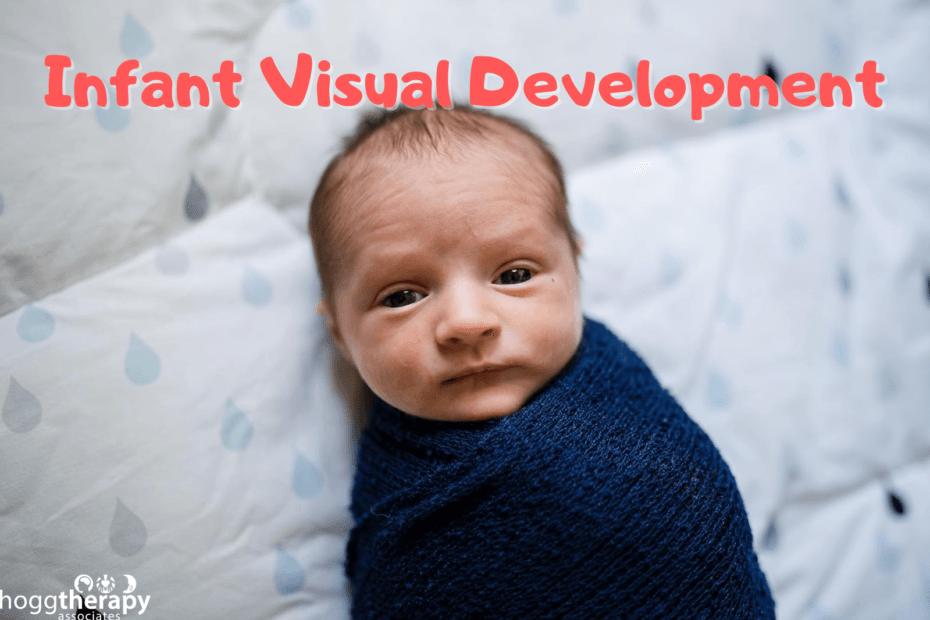
What can baby see?
Babies explore their world through their senses- especially vision, at early ages. Healthy visual development is important as your child ages. Below are important visual milestones, and ways to help your child learn and achieve through play!
AT BIRTH- As a newborn, a baby can typically see high contrast colors, such as black and white. They can see clearly only up to 8 to 10 inches away. Their eyes do not move in a focused manner.
TWO MONTHS- At eight weeks old, babies begin to get better focus with their vision. They enjoy looking at their parent’s faces and colorful objects, and the earliest colors they can see well are white, black, and red. It is ok if a babies eyes apparently appear to wander in different directions or crossed, as long as they don’t stay that way for long periods.
THREE MONTHS- Babies should be starting to watch and move their eyes to follow moving objects around three months old.
FIVE MONTHS- 3D vision, or depth perception, begins to develop around 5 months old, as well as baby’s color vision becoming more detailed.
EIGHT MONTHS- Babies typically begin crawling around this age, which helps develop their hand-eye coordination. It is important to encourage crawling, even if your child shows signs of early walking, to help develop this hand-eye coordination.
NINE MONTHS- Babies continue to use their hand eye coordination to start pulling up to stand.
TEN MONTHS- Fine motor and visual skills work together to help baby grasp small objects with their thumb and index finger, in a “pincer” grasp.
TWELVE MONTHS- Baby will be crawling, and possibly trying to walk. They can now assess distance better, and throw objects, with well-developed depth perception.
Potential Signs of Visual Processing Problems
-Not reaching for objects around 4 months
-Not watching moving objects with their eyes around 2 months
-Not looking at objects in their hands around 3 months
-Eyes that stay crossed or one wanders for long periods of time
It is important to remember that babies develop at different rates, so being slight behind the targets above may not be a cause for concern. If you do have concerns about vision, speak with your child’s pediatrician. Occupational therapists can help with hand eye coordination, and an optometrist can eyesight.
What parents can do to help with visual development
There are many things parents can do to help their baby's vision develop properly. The following are some examples of age-appropriate activities that can assist an infant's visual development.
Birth to 4 months
- Place a nightlight in baby’s room
- Change the directions you lay baby down in their crib to encourage turning their head different directions.
- Place baby on a play mat with toys within 1 foot of their face
- Change which side you feed baby on at each feed
5 to 8 months
- Hang items above the crib or strapped to the side of the crib for baby to reach and kick at
- Play on the floor with baby to encourage exploring
- Play movement games or sing songs while moving baby’s arms and legs
9 to 12 months
- Play hide and seek games with toys or your face
- Encourage crawling and pulling to stand to increase hand eye coordination
1 to 2 years
- Roll a ball back and forth to help baby track with their eyes
- Encourage play with blocks to increase hand eye coordination and fine motor skills
Check us out on Pinterest!